Shop
Shop
Filters
A seven-module curriculum built around the protective factors that actually predict resilience — not vague positivity, not one-size-fits-all generic worksheets. 170 slides total.
Resilience isn't a personality trait, and it isn't luck. Research consistently points to a specific set of protective factors — emotional regulation, adaptability, problem-solving, a settled relationship with your body, physical stewardship, and a sense of meaning. These determine whether someone bends or breaks under pressure. The Root System takes each of those factors and turns it into something teachable: a structured module with a clear rationale, real skills, and guided practice/activities, instead of a single worksheet that touches the surface and moves on. Each module contains tier-specific discussion prompts to cater to the developmental differences facing teenage girls, college age women, and adult women.
For Clinicians
This is a full, session-ready curriculum grounded in the actual research on protective factors, not just a themed activity pack. Every module includes a clinical rationale, measurable learning objectives, and targeted skills, so it holds up to the same scrutiny you'd apply to any resource entering your practice. Whether you're running individual sessions, a therapy group, or a structured psychoeducational series, the material is built to be used as-is — no assembling a curriculum out of scattered resources yourself.
For Individuals
This isn't a stack of generic affirmations, and it isn't about fixing something broken in you. It's a structured path through the specific things that build resilience, including how you relate to your emotions, your setbacks, your body, and your sense of purpose, with room to write, reflect, and return to as your life changes.
What's included:
The full presentation deck, covering all seven core protective factors:
Emotional Well-Being & Emotional Intelligence
Frustration Tolerance & Emotional Regulation
Adaptability, Resilience, and Internal Control
Problem-Solving, Coping, and Conflict Resolution
Body Image, Care, and Protection
Physical Health & Body Stewardship
Spiritual Faith & Cultural Beliefs
Module 1 psycho-education includes: What emotional intelligence is (and why it's a skill, not a trait), Emotional granularity( naming feelings with real precision), The emotion-thought-body connection, Recognizing personal emotional patterns, Cover emotions vs. core emotions (what's underneath the first feeling that shows up), What empathy is, and isn't, The 4-step framework for communicating emotions effectively. Module 1 activities include: The Feeling Wheel Expansion, Body-Emotion Mapping, My Emotional Landscape, Empathy Mapping, Tier-differentiated discussion prompts + key takeaways + between-session practice
Module 2 psycho-education includes: What frustration tolerance actually is, The Window of Tolerance, difference between coping and avoiding, A full Regulation Skills Menu, How to identify your personal triggers, Reading your own early warning signals. Module 2 activities include: Coping or Avoiding (sorting exercise), My Coping Patterns Audit, My Regulation Toolkit, My Frustration Ladder, Tier-differentiated discussion prompts + key takeaways + between-session practice.
Module 3 psycho-education includes: What resilience is and is not , The Root System tree metaphor for bending vs. breaking, Locus of control, Cognitive flexibility. Module 3 activities include: Your Resilience Narrative, My Locus of Control Assessment, Fixed to Flexible — Mindset Reframe Practice, Tier-differentiated discussion prompts + key takeaways + between-session practice
Module 4 psycho-education include: Why people avoid problems, The real cost of leaving problems unsolved, STOP-THINK-ACT decision-making framework, Coping styles (problem-focused, emotion-focused, social), Help-seeking as a resilience skill, not a weakness, Why conflict feels dangerous, and where that response comes from, The Communication Spectrum, Assertive Communication Formula, De-escalation strategies. Module 4 activities include:STOP-THINK-ACT in Practice, My Coping Style Self-Assessment, Practicing Assertive Communication, Tier-differentiated discussion prompts + key takeaways + between-session practice
Module 5 psycho-education includes: What body neutrality actually means, The Body Image Continuum, Where body image beliefs actually come from, Separating image language from function language, Body-based safety and personal boundaries, Nourishing vs. punitive self-care.Module 5 activities include:Body Story, Media Message Deconstruction, Body Messages Worksheet, Personal Care Values Clarification, Tier-differentiated discussion prompts + key takeaways + between-session practice
Module 6 psycho-education includes Body stewardship as an alternative to fitness culture, The Four Pillars, Why physical health directly supports mental health, Common barriers to sustainable habits, Intuitive movement, Sleep hygiene fundamentals, Nutritional attunement. Module 6 activities include: Physical Health Wheel, Joyful Movement Exploration Brainstorm, Values-Based Health Vision Statement, Tier-differentiated discussion prompts + key takeaways + between-session practice.
Module 7 psycho-education includes: What meaning-making is, The five Sources of Meaning, Why meaning matters for resilience specifically, Common blocks to meaning-making, Cultural identity as an active strength, Mapping belonging across overlapping communities, Developing a personal philosophy of meaning. Module 7 activities include: What Gives My Life Meaning?, Cultural Values Inventory Brainstorm, Belonging Web, Tier-differentiated discussion prompts + key takeaways + between-session practice.
The companion workbook — 27 fillable components across all seven modules, each with a "why this helps" rational to help deepen individual understanding of why the strategies are being utilized.
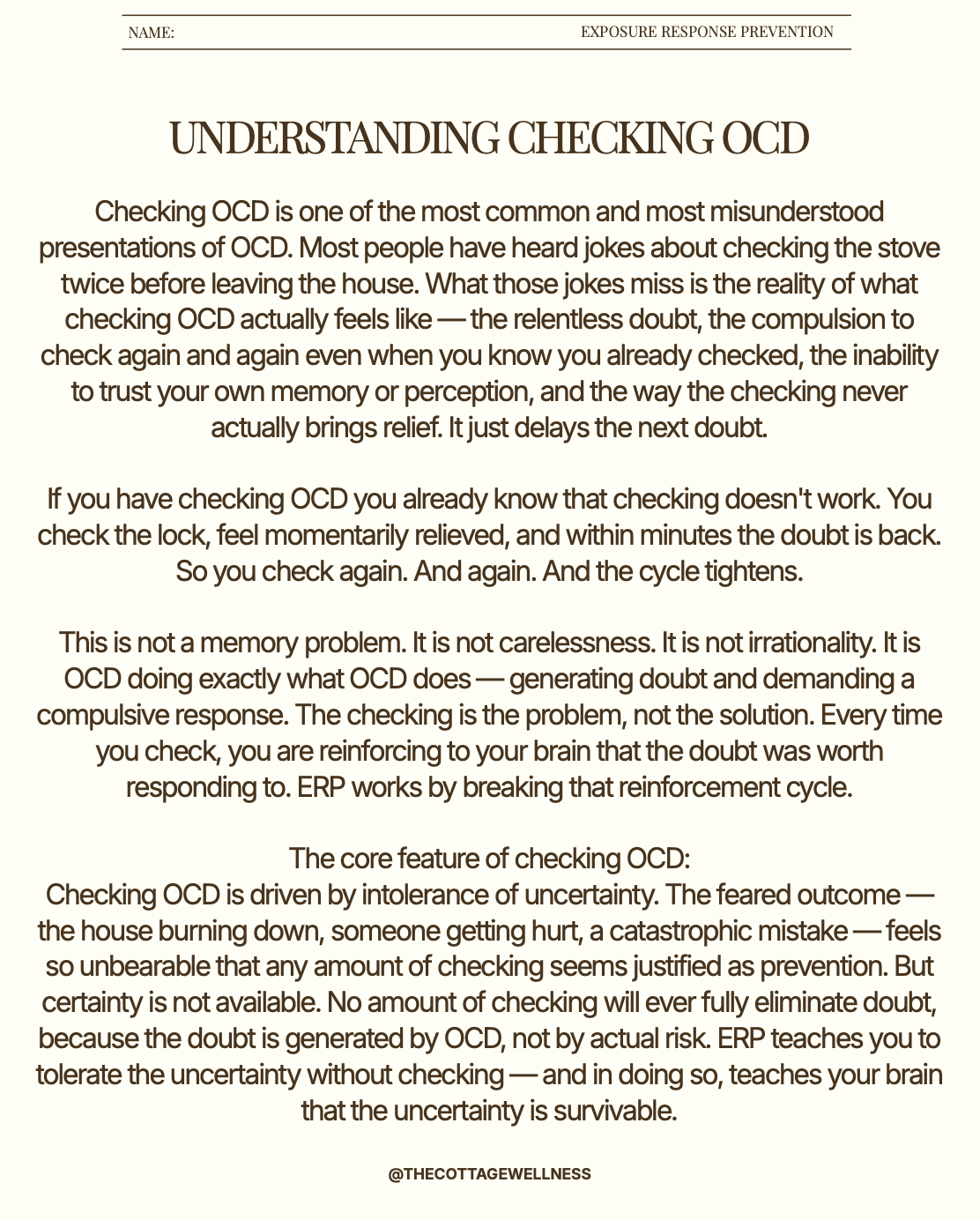
You already know that checking doesn't work. You check the lock, feel momentarily better, and within minutes the doubt is back. So you check again. And the cycle tightens. This worksheet gives you the tools to break that cycle — for good.
Built by a licensed therapist specializing in OCD, this comprehensive ERP resource covers all five major checking OCD presentations in one place. Whether your checking involves locks and appliances, hit and run fears, mistakes at work, reassurance seeking, or body checking — this worksheet has a hierarchy and response prevention plan built specifically for you.
What's inside:
A plain-language explanation of checking OCD and why checking makes the doubt stronger, not weaker.
A compulsions guide covering physical, mental, and reassurance-seeking compulsions — including the subtle mental reviewing that most people miss.
The golden rule of checking ERP — one mindful check is enough, the second check is always the OCD.
A long-term goals and values section to anchor your work in what matters.
A comprehensive list of exposure examples covering physical checking, hit and run OCD, mistake checking, reassurance seeking, and body checking.
Imaginal exposures for checking OCD.
A response prevention guide.
This worksheet is for you if: You have checking OCD and want a structured, comprehensive ERP tool, you are in therapy and want something to use between sessions, or you are a therapist looking for a client-facing checking OCD resource.
This worksheet is for educational purposes only and is not a substitute for therapy or clinical treatment.
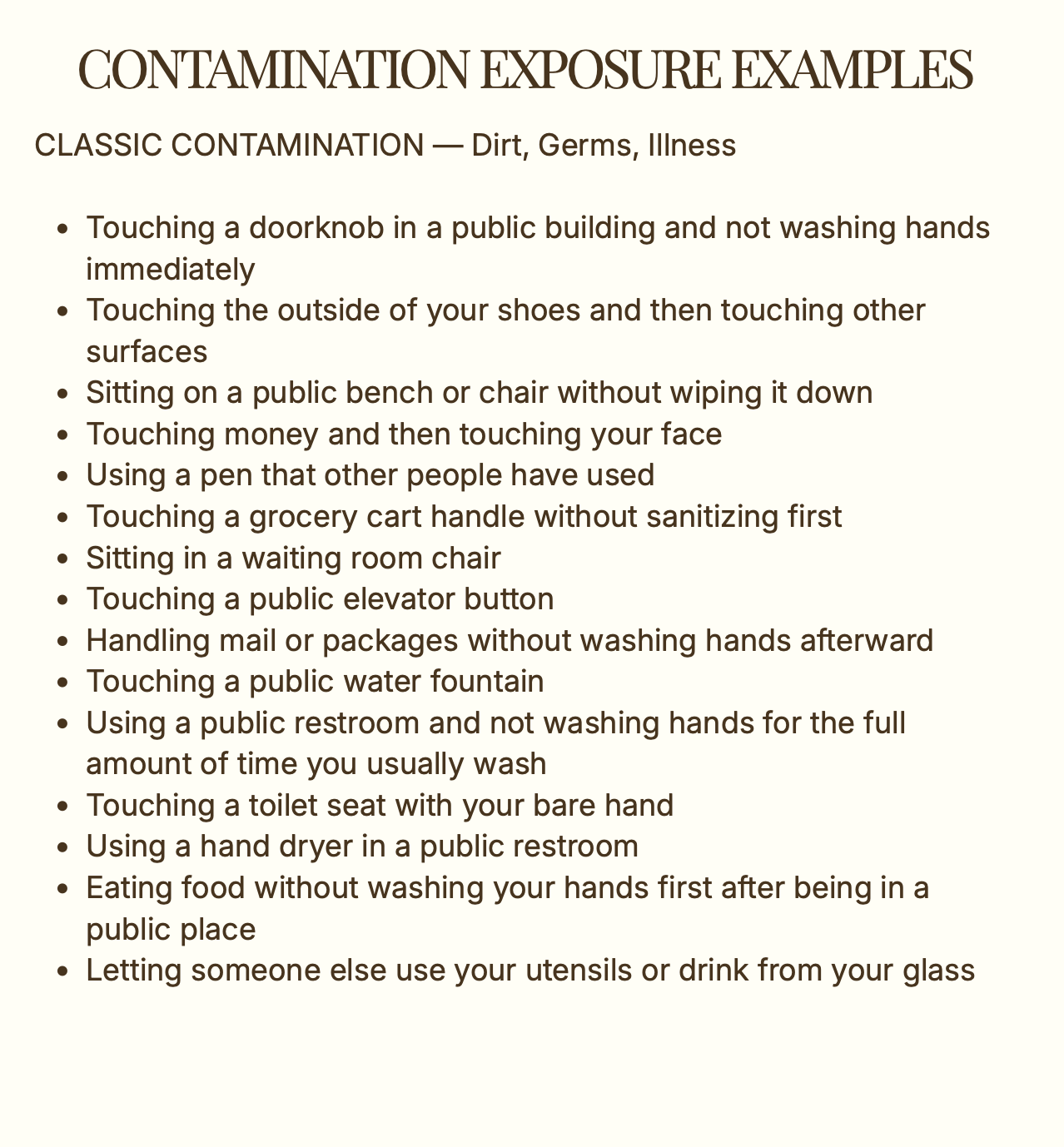
If you have contamination OCD, you already know that avoiding the things that trigger you doesn't make the anxiety go away, it just makes your world smaller.
This worksheet gives you a structured, evidence-based roadmap for doing the one thing that actually works — Exposure and Response Prevention (ERP). Built by a licensed therapist specializing in OCD, this is not a generic anxiety worksheet. It is a clinically grounded, practical tool designed specifically for contamination OCD.
What's inside:
A plain-language explanation of how ERP works and why it is the gold standard treatment for OCD.
A guide to building your personal exposure hierarchy using SUDS ratings.
A comprehensive exposure example list covering five contamination subtypes — classic contamination, bodily fluids, chemicals and toxins, spreading harm to others, and moral contamination.
A response prevention guide covering physical, mental, and behavioral compulsions.
A long-term goals and values section to anchor the hard work in something meaningful.
This worksheet is for you if: You have contamination OCD and want a structured tool to begin or deepen ERP work. You are in therapy and want a resource to use between sessions. You are a therapist looking for a client-facing ERP resource for contamination OCD.
A note on using this worksheet: This resource is designed to work both as a self-guided tool and as a therapy companion. If you are working independently, start at the bottom of your hierarchy and work up gradually. If you find yourself significantly worsening or unable to engage with the material, please reach out to a therapist trained in ERP. A directory is available at iocdf.org.
This worksheet is for educational purposes only and is not a substitute for therapy or clinical treatment.
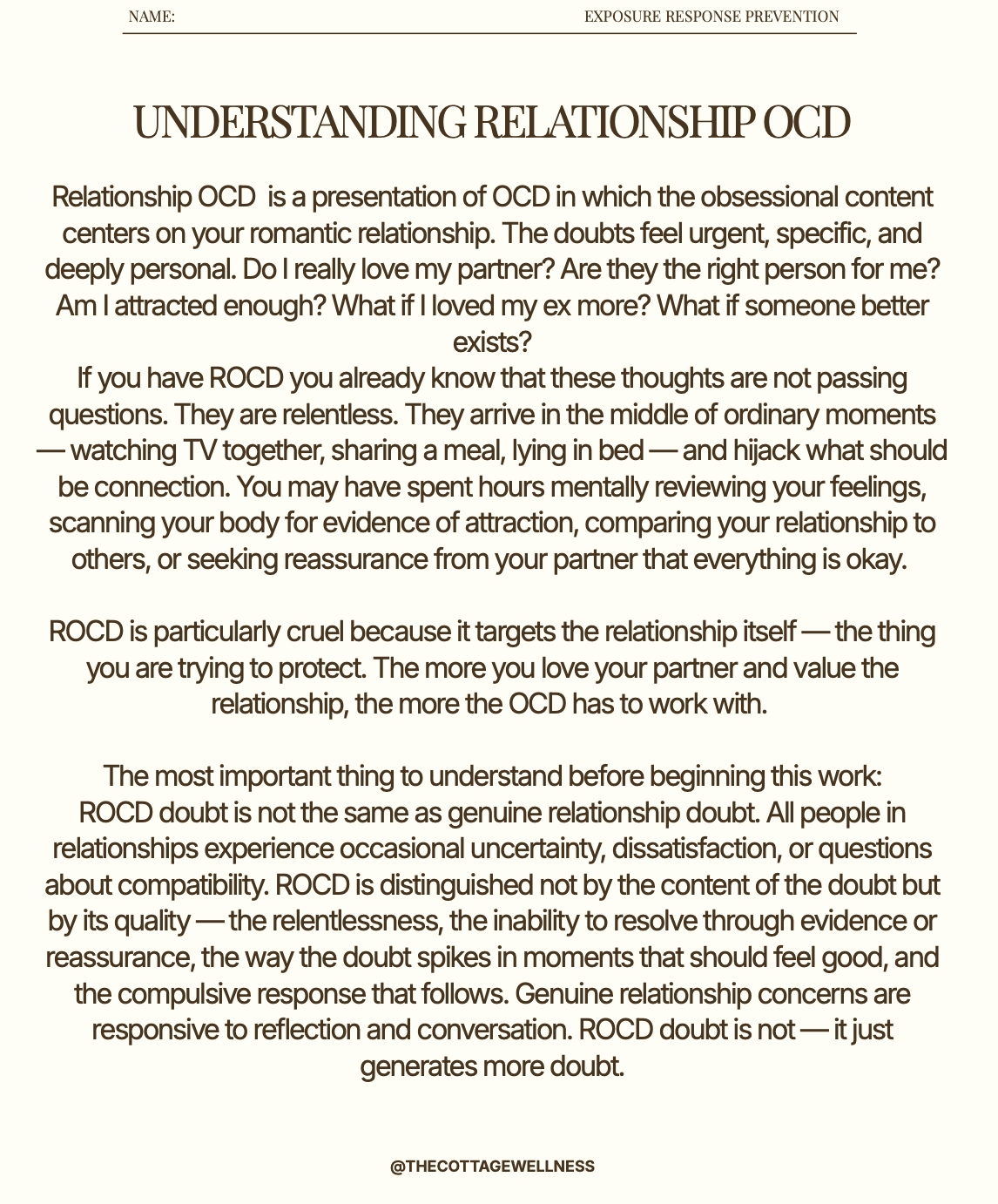
Relationship OCD takes the thing you are trying to protect — the love, the connection, the future you are building — and floods it with doubt. Do I really love my partner? Are they the right person? What if I loved my ex more? What if someone better exists? If you know this cycle, this worksheet was built for you.
Developed by a licensed therapist specializing in OCD, this is a comprehensive, clinically grounded ERP resource for relationship OCD — one of the most common and least discussed OCD presentations. It covers the full picture including psychoeducation, exposure hierarchies, imaginal exposures, response prevention, and a dedicated section for partners.
What's inside:
A psychoeducation section on ROCD including what distinguishes it from genuine relationship concerns.
An honest guide to the question everyone with ROCD asks — is this OCD or a real relationship problem?
A compulsions guide covering mental compulsions, reassurance seeking, and partner accommodation.
Thorough exposure examples covering doubt about feelings and attraction, doubt about partner and the fear that someone better exists, and doubt about past relationships.
Imaginal exposures for ROCD.
A response prevention guide including the core uncertainty statement for ROCD.
A long-term goals and values section.
A dedicated note to partner and loved ones — what ROCD looks like from the outside, why reassurance makes it worse, and how to support without accommodating.
This worksheet is for you if: You have relationship OCD and want a structured ERP tool that actually addresses the full complexity of the presentation. You are in therapy and want something to support your work between sessions. Your partner has ROCD and you want to understand what is happening and how to help. You are a therapist looking for a comprehensive ROCD resource for clients.
This worksheet is for educational purposes only and is not a substitute for therapy or clinical treatment.
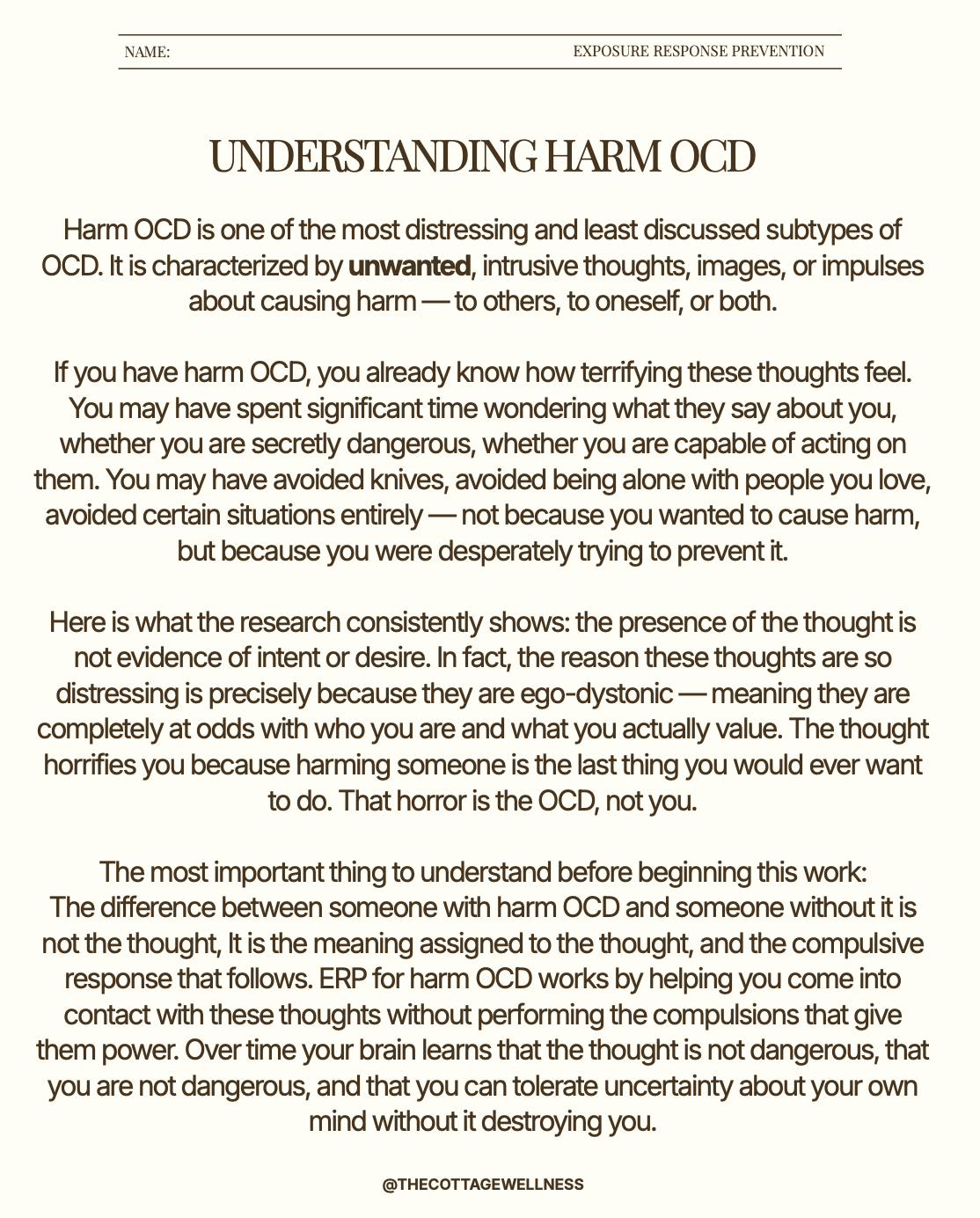
If you have harm OCD, you have probably spent significant time wondering what your thoughts say about you. Whether you are secretly dangerous. Whether the thoughts mean something. They don't, and this worksheet will help you understand why — and what to do about it.
Built by a licensed therapist specializing in OCD, this is a comprehensive, clinically grounded ERP resource for both harm to others OCD and self-harm OCD. It covers the full picture — the psychoeducation, the hierarchy, the imaginal exposures, and the response prevention — in plain language that actually makes sense.
What's inside:
Psychoeducation section explaining the ego-dystonic nature of harm OCD.
A compulsions guide covering both harm to others and self-harm OCD presentations.
A long-term goals and values section connecting ERP work to what actually matters to you.
A comprehensive list of exposure examples covering both in vivo and imaginal exposures across both presentations.
A response prevention guide with specific attention to the mental compulsions that drive harm OCD.
This worksheet is for you if: You have harm OCD — intrusive thoughts about hurting others or yourself — and want a structured ERP tool, you are working with a therapist and want a resource to support your work between sessions, or you are a therapist looking for a clinically grounded harm OCD resource for clients.
Important clinical note: Self-harm OCD involves unwanted, ego-dystonic intrusive thoughts about self-harm that cause significant distress. They are clinically distinct from suicidal ideation. If you are uncertain whether what you are experiencing is OCD or genuine suicidal ideation, please speak with a licensed mental health professional before using this worksheet. If you are in crisis, please contact the 988 Suicide and Crisis Lifeline by calling 988.
This worksheet is for educational purposes only and is not a substitute for therapy or clinical treatment.
Every therapist knows the feeling. The session stalls, the client goes silent, shuts down, or says "I don't know" for the fourth time. You're not sure whether to push, wait, redirect, or name it — and the clock is ticking. This mini guide was built for exactly those moments.
Developed by a Licensed Clinical Professional Counselor (LCPC) and PMH-C with specialized training in OCD, perinatal mental health, trauma-informed care, ADHD, and anxiety, this is a practical, clinically grounded resource for therapists, trainees, and supervisees navigating the stuck moments that supervision doesn't always have time to cover.
What's inside:
Seven of the most common therapeutic impasses — explored with clinical nuance, practical strategies, and specific questions to reach for when you're in the moment.
The seven stuck moments covered:
The client who goes silent — how to read the silence, when to speak, and what to say when you do. The client who says "I don't know" — why it happens, what is usually behind it, and the single most useful follow-up question in most situations. The client who isn't talkative — differentiating between ambivalence, hypoarousal, and not knowing how to use therapy. The client who intellectualizes — how to interrupt the defense without shaming it and redirect toward genuine emotional access. The client who is overwhelmed — how to recognize when a client has left their window of tolerance and what to do before anything else can happen. The client who is defensive — why matching defensiveness with persistence always makes it worse and what to do instead. The client who dismisses progress — why acknowledging improvement feels dangerous for some clients and how to explore it without arguing for it.
For each stuck moment you get:
A clinical explanation of why it happens — including the most commonly missed reasons. A practical strategy section and a specific question/statement bank — exact language you can adapt and bring into session.
This guide is for you if:
You are a therapist, counselor, social worker, or psychologist who wants a deeper clinical framework for the moments that feel most uncertain. You are a trainee or practicum student who wants to understand these dynamics before you encounter them. You are in supervision and want a resource to bring to those conversations. You work with OCD, anxiety, trauma, or perinatal clients and find these presentations particularly prone to therapeutic impasse.
A note on how to use this:
These are clinical frameworks and question banks designed to be adapted to your specific client, your specific relationship, and your specific moment. The best way to use this guide is to read it between sessions, bring the questions you find most useful into your clinical vocabulary, and take the material to supervision for context and application.
This guide is intended for professional educational purposes only. It does not constitute clinical supervision, formal training, or continuing education credit. Clinicians are responsible for practicing within their scope of licensure and for seeking appropriate supervision when indicated. © The Cottage. All rights reserved.
You will get a PDF (21MB) file
No results found
No results match your search. Try removing a few filters.